Bayesian phylogenetic analysis of Japonic languages

May 6, 2011 in Uncategorized

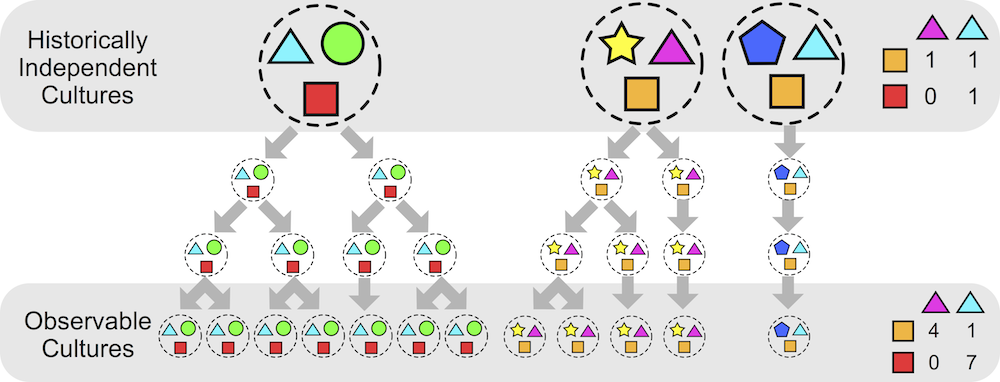
Lee & Hasegawa (2011) use phylogenetic methods to trace the origins of Japonic languages and dialects.  Two hypotheses are considered:  First, the farming/language dispersal hypothesis posits that the main factor for the divergence of genetic and linguistic diversity was agricultural expansion.  Second, the diffusion/transformation hypothesis posits that cultural innovations such as farming can diffuse between societies, and so genetic and linguistic diversity should not be linked.  The estimate of the common linguistic ancestor was in accordance with the farming/language dispersal hypothesis, again suggesting that that linguistic diversity followed genetic diversity.

The study is notable in considering dialects as well as languages and using etymology dictionaries to reconstruct forms from Middle and Old Japanese.  The analysis is also done with their own reconstructions and another, unrelated set.  The technique is similar to that used by Russel Gray et al. (2009) to study Pacific settlement patterns.

Lee S, & Hasegawa T (2011). Bayesian phylogenetic analysis supports an agricultural origin of Japonic languages. Proceedings. Biological sciences / The Royal Society PMID: 21543358

Gray, R., Drummond, A., & Greenhill, S. (2009). Language Phylogenies Reveal Expansion Pulses and Pauses in Pacific Settlement Science, 323 (5913), 479-483 DOI: 10.1126/science.1166858

Cultural bottlenecks leads to Diversity in Birdsong

May 4, 2011 in Abstracts, Science News

A new study has been conducted on dialect formation in birds:

Native North Island saddlebacks have developed such distinctive new songs in the past 50 years that it is not clear if birds on one island recognise what their neighbours are singing about, a Massey University study shows.

The phenomenon is an avian equivalent of the way human language develops regional accents and dialects as people migrate and settle in new locations, and provides fresh insights into how species evolve, says biology researcher Dr Kevin Parker, from the Institute of Natural Sciences at Albany.

I can’t find any published article but the press release is here.


Linguistic Structure: the Result of L2 Learners?

May 2, 2011 in Irreverant and Irrelevant, Linguistics

Wray and Grace (2007) propose that the structure of a language is dependent of the social structure of the population who speak it. Lupyan & Dale (2010) later showed this using statistical analysis. This has been discussed extensively on this blog before:

http://www.replicatedtypo.com/science/language-as-a-complex-adaptive-system/422/

http://www.replicatedtypo.com/uncategorized/memory-social-structure-and-language-why-siestas-affect-morphological-complexity/2382/

One of the proposed reasons for why large population size is thought to affect linguistic structure is that larger populations will have a larger ratio of second language (L2) speakers to first language (L1) speakers.

Languages within exoteric niches (large population and geographical spread with many language neighbors) have been shown to be more more morphologically isolating and, as a result, regular. This has proposed to be because of the biases of adult second language learners.

Esoteric languages are more irregular and morphologically complex and idiosyncratic. This is thought to be because of the biases of child learners.

There are studies which show that adult learners have a tendency to regularise languages but only under some circumstances. Hudson Kam & Newport (2009) show that adult learners will regularise unpredictable variability but only if it exists above a certain level of scatter and complexity.

As for the learning biases of children, Wray & Grace (2007) cite only one study which looked at children who were ‘native’ speakers of Esperanto (Bergen, 2001). Bergen (2001) found that the language that the children learnt displayed a loss of the accusative case and also displayed attrition in the tense system. Although Wray & Grace (2007) suggest that this explains patterns seen in esoteric communities, it may not be as straight forward as they suggest. The evidence suggests that esoteric conditions are going to display more morphological strategies in their languages which is the opposite to the biases the child learners of Esperanto are displaying. The children are rejecting morphological strategies in favour of attrition and word order.

I wanted to point out in this post that there is evidence to suggest that adult learners preserve irregularities and idiosyncrasies, while children learners regularize (suggesting the opposite to Wray & Grace).

Studies which have addressed these problems include Hudson Kam & Newport (2005) where adult learners of an artificial language preserved unpredictable variation and child learners of the same language regularized it. Hudson Kam & Newport (2009) show in a similar study that child learners of an artificial language will regularise unpredictable irregularity but, as mentioned above, adult learners will only do this where the irregularity passes a certain level of complexity.

However, some evidence does support Wray & Grace’s (2007) proposal about adult learners.  Smith & Wonnacott (2010) show that despite there being a tendency within individual adult learners to maintain the level of unpredicted variability within the language learning process, when put into a diffusion chain of adult learners the language regularises.  Smith & Wonnacott (2010) suggest that gradual processes such as this can explain the regularisation of languages over time. While this fits nicely with Wray & Grace’s (2007) theory there is still the problem that children are just as liable to regularise as adults if not more so.


This is just some relevant experiments which I thought lent something to the debate. I know there are other factors which have been proposed to have an effect on linguistic structure. I was just curious about people’s opinions on quite to what level L2 speakers have an effect.

Recall dependent on language?

April 30, 2011 in Abstracts, Evolution

A new study has been published in Current Biology which offers evidence to suggest that monkeys have the capacity for both recognition and recall of simple shapes.

The study showed that rhesus monkeys can recall shapes from memory. This was shown using an experiment which had the monkeys reproduce shapes on a computer touch screen. These findings suggest that the memory of humans and old world monkeys may be more similar than we previously suspected.

Recall is separate and special in comparison to recognition as it shows an ability to remember and visualise things which are not present in the moment. This is an ability which is implicated in skills such as planning and imagining. This is also thought to enhance things like navigation and social behavior. In the past it has thought that an ability to recall none present items is dependent on language. This has been suggested in the past by prominent linguists such as Charles Hockett who thought that the ability of displacement was facilitated by language and was a driving force behind its evolution.

Because of a lack of demand for recall in the lives of monkeys they will not use their recollection skills very often in the wild. In the press release, Benjamin Basile, who lead the study said:

“Maybe it’s often just easier to recognize the monkey, the food, or the landmark in front of you. What we do know is that they do seem to have the ability to recall information in the lab.”

Experiments with humans have shown that recall and recognition require different types of memory. This has been difficult to show with other primates as recall tests are difficult to devise for monkeys because they can’t draw or talk.

The experiment used five rhesus monkeys who were trained on a recall test in which they had to reproduce a simple figure on a touch screen from memory. The shapes were made up of large pixels or boxes on a screen. The monkeys were shown these shapes and then, after a delay, were presented with part of the shape in a different location. The monkeys had to replicate the rest of the shape by touching where the other pixels should be.

The monkeys remembered less in recall than in recognition tests which is the same case in humans. However, the recall performance deteriorated more slowly over time. The monkeys were also able to transfer their ability to recall shapes to novel shapes as they were shown to be able to recall shapes which weren’t used in training.

This ability has probably been present since our last common ancestor with old world monkeys some 30 million years ago and is probably not facilitated by language.

The study hypothesises that:

“Recollection and familiarity likely evolved because they solved functionally incompatible problems. For example, familiarity does not support detailed memory for context, but it is quick and resistant to distraction. Recollection is slower and more vulnerable to distraction but supports a more detailed and flexible use of memory. Familiarity might better allow rapid responses to foods and predators under distracting conditions, whereas recollection might be necessary to access knowledge of distant food locations or past social interactions for planning future behavior.”

References

Benjamin M. Basile, Robert R. Hampton. Monkeys Recall and Reproduce Simple Shapes from MemoryCurrent Biology, 28 April 2011


Chris Knight Arrested

April 29, 2011 in Irreverant and Irrelevant

Sorry, this isn’t really Language Evolution related besides Chris Knight’s obvious connection to the subject but thought it would be of interest to readers of the blog.

Last night Chris Knight and Camilla Power were arrested after planning to execute effigies of Prince William at Westminster Abbey. They were arrested ahead of the royal wedding today.

A professor of anthropology at the University of East London, Chris Knight along with his partner, Camilla Power, also a anthropology lecturer at UEL, were arrested outside their home in southeast London at around 6.15pm.

They were arrested on suspicion of conspiracy to cause public nuisance and breach of the peace.

Dr Knight was seen laid down on the pavement during the arrest in an attempt to stop officers moving him into a police van. But the police prevailed and they were held in a police station overnight.

This is not the first time Dr Knight has caused trouble. He was sacked from his position in 2009, following claims that he incited violence at the G20 protests.

THE add that the camera man who was at the scene of the arrest asked Dr Knight: “Can I get your house keys so I can feed the rabbit?”

I do hope that the rabbit is OK.


Bonobos Extract Meaning from Call Sequences

April 28, 2011 in Abstracts, Science

A new study appeared yesterday on PlosOne by Clay and Zuberbühler of St Andrews University on the communicative ability of bonobos.

Studies have been done in the past on language-trained bonobos such as Kanzi which have revealed some remarkable abilities that the species has with regards to representational and communication tasks.

These studies have focussed on trained apes which are reared in unnatural environments and extensively trained on artificial languages. This has produced some interesting results though research into bonobos’ natural communication has been thin on the ground until now.

Clay and Zuberbühler address this gap in the research with a playback study on the natural vocal communication of bonobos.

Bonobos are known to produce five distinct vocal signals when finding food, these have been demonstrated to be combined together to make longer call sequences. The study found that individual call types were poor indicators of food quality but that calls which displayed a concatenation of signals were much better indicators.

The study looked into whether receivers could extract meaning about the quality of food encountered by the caller by integrating across different call sequences.

They started by training four captive bonobos to find two types of foods in two different locations, those which are more preferred such as kiwis and those which are less preferred such as apples. The apes were recorded when finding these different food types and these recordings were used in the playback experiments. When the bonobos discovered their preferred food they emitted higher pitched long barks and short “peeps” and when they discovered the less-preferred food they made lower pitch “peep-yelps” and yelps. Sequences of the four calls which used different compositions were played back to bonobos who were familiar with those apes who had originally made the calls. All sequences contained the same number of calls. In response to these playbacks the study found that the apes devoted significantly more effort and time searching the space which was known to contain the food type indicated by the call sequence (shown in the graph below).


The bonobos were shown to attend not just to individual calls but to the entire sequences before they made inferences about the food encountered by a caller.

These results provide the first empirical evidence that bonobos are able to extract information about external events by attending to natural vocal sequences made by other bonobos. This study really highlights the importance of call combinations in their natural communication system.

References
Clay Z, Zuberbühler K, 2011 Bonobos Extract Meaning from Call Sequences. PLoS ONE 6(4): e18786. doi:10.1371/journal.pone.0018786

Neanderthal-human Hybrids

April 27, 2011 in Abstracts, Science

Paul Mason and Robert Short have an article out called Neanderthal-human hybrids (I wonder what that’s about?). Here is the abstract:

Evidence from studies of nuclear and mitochondrial DNA extracted from Neanderthal fossils and humans points to fascinating hypotheses concerning the types of interbreeding that occurred between these two species. Humans and Neanderthals share a small percentage of nuclear DNA. However, humans and Neanderthals do not possess the same mito­chondrial DNA. In mammals, mitochondrial DNA is exclusively maternally inherited. Taking into account an understanding of interspecific hybridity, the available data leads to the hypothesis that only male Neanderthals were able to mate with female humans. If Haldane’s Law applied to the progeny of Neanderthals and humans, then female hybrids would survive, but male hybrids would be absent, rare, or sterile. Interbreeding between male Neanderthals and female humans, as the only possible scenario, accounts for the presence of Neanderthal nuclear DNA, the scarcity of Neanderthal Y-linked genes, and the lack of mitochondrial DNA in modern human populations.

Paul Mason previously wrote about the topic over at Neuroanthroplogy, so I really don’t have much more to say on the topic, other than that I’ll get around to reading it over the next couple of days. I’m curious to see if the usual suspects in the genetics (Razib Khan), anthropological (Dienekes) and evolutionary (John Hawks) communities offer some food for thought on the topic.

For me, I’m actually more interested in Mason’s recent work on degeneracyBut that’s for a later post ;-)

Academic Blogging

April 26, 2011 in Academia

Natalia Cecire has a good post on academic blogging over at Arcade. Tne ensuing discussion is excellent.

Here’s what I posted to the discussion:

Excellent post, Natalia, and excellent discussion all.

I come at this subject from a different angle. I was trained as an academic, held an academic post, then failed to get tenure. Since then I’ve done this and that, while maintaining an active intellectual life. The advent of the web was a godsend to me, for it opened up new lines communication. Now I could easily find out about things and stuff and contact any scholar with an email address. I was once again in the mix, though a somewhat different mix, to be sure.

It’s within that context that I see my blogging. I do most of my blogging at my own blog, New Savanna, which is a mixture of various things. I could easily break it into 3 or 4 more tightly focused blogs, but why do that? (Perhaps readers would be less confused.) I post photos, personal essays (not so many of those), and material on a wide variety of topics at varying levels of sophistication and intellectual development.

I’m particularly fond of the work I’ve been doing on cartoons, most of which is analytic and descriptive. I regard that as being as important as anything I’m doing, but I don’t see how I could do that work in a formal academic venue. As far as I know, there’s no place to publish largely analytic descriptive work on cartoons. So I blog it. Most recently, a series of four posts on Porky in Wackland and eight on The Greatest Man in Siam. While some of those posts get just a tad heavy here and there, for the most part they’re pretty straightforward and accessible. Anyone who’s interested in that material can read those posts. And there’s a substantial community of folks interested in animation that isn’t being served by academia.

So, I’m a public intellectual without the reputation that seems to be part of the implicit understanding of the term. Read the rest of this entry →

Replicated Hauser Results

April 25, 2011 in Science News

Some of you may remember last summer Marc Hauser was found guilty of research misconduct. This investigation raised questions about several publications including a paper from 2007 in Science. This paper looked into the ability of non-human primates to understand the intentions of a human experimenter by interpreting his gestures.

Today Science has published a partial replication of the study in question which confirms the original findings that chimpanzees, cotton-top tamarins, and rhesus macaques can distinguish intentional gestures, such as pointing to indicate a container with food inside, from “accidental” actions such as a hand flopping against a container.

The Science wesite states the following:

Following the Harvard misconduct investigation, first author Justin Wood, now an assistant professor at the University of Southern California in Los Angeles, wrote to Science in June 2010 to notify the journal that the investigation had revealed that the original field notes for the rhesus experiments could not be found:

“An internal examination at Harvard University determined that there are no field notes, records of aborted trials, or subject identifying information associated with the rhesus monkey experiments; however, the research notes and videotapes for the tamarin and chimpanzee experiments were accounted for. Professor Hauser states that “most of the rhesus monkey observations were hand written by [co-author David D.] Glynn on a piece of paper, and then the daily results tallied and reported to Wood over email or by phone” and then the raw data were discarded. The research assistant who performed the experiments (Glynn) confirmed that these field notes were discarded.”

Hauser and Wood returned to Cayo Santiago island in Puerto Rico to redo the experiments from the 2007 paper with the same population of free-ranging rhesus monkeys. Their findings, including field notes and video trials, are available online and they essentially match those reported in the original paper.

It is still not known what went wrong with the original experiment, a statement issued by Science today only says the following:

We stress that this new publication aims only to determine whether the original rhesus monkey experiments from the 2007 paper can be replicated. It has no bearing on questions raised about Dr. Hauser’s larger body of work.

This article from Science Inside quotes Dario Maestriperi as saying:

“The results of this replication are straightforward and entirely consistent with those of the original study. If the authors’ interpretation of their results is correct, these findings are very important and represent one of the clearest demonstrations that nonhuman primates can interpret the behavior of other individuals as intentional or non-intentional….Since the experimenter who tested the rhesus monkeys in the replication study appeared from the video to be the first author on the paper, Justin Wood, he was clearly knowledgeable of the hypotheses being tested and had some strong expectations and desires about the monkeys’ performance on the test.”

So is this replication a clarification of groundbreaking findings or could the monkey’s behaviour be down to the Clever Hans effect?

Meanwhile investigations into Hauser’s research are still ongoing and he is still banned from teaching for the next academic year.


New Book. New Ideas?

April 21, 2011 in Reviews

A new book is to be published on May the 24th. By John F. Hoffecker the book is entitled “Landscape of the Mind: Human Evolution and the Archaeology of Thought” – it aims to look at the emergence of human thought and language through archaeological evidence

Archeologists often struggle to find fossil evidence pertaining to the evolution of the brain. Thoughts are a hard thing to fossilize. However, John Hoffecker claims that this is not the case and fossils and archaeological evidence for the evolution of the human mind are abundant.

Hoffecker has developed a concept which he calls the “super-brain” which he hypothesises emerged in Africa some 75,000 years ago. He claims that human’s ability to share thoughts between individuals is analogous to the abilities of honey bees who are able to communicate the location of food both in terms of distance and direction. They do this using a waggle-dance. Humans are able to share thoughts between brains using communicative methods, the most obvious of these being language.

Fossil evidence for the emergence of speech is thin on the ground and, where it does exist, is quite controversial. However, symbols emerging in the archaeological record coincides with an increase in evidence of creativity being displayed in many artifacts from the same time. Creative, artistic designs scratched on mineral pigment show up in Africa about 75,000 years ago and are thought to be evidence for symbolism and language

Hoffecker also hypothesises that his concept of the super-brain is likely to be connected to things like bipedalism and tool making. He claims that it was tool making which helped early humans first develop the ability to represent complex thoughts to others.

He claims that tools were a consequence of bipedalism as this freed up the hands to make and use tools. Hoffecker pin points his “super-brain” as beginning to emerge 1.6 million years ago when the first hand axes began to appear in the fossil record. This is because hand axes are thought to be an external realisation of human thought as they bear little resemblance to the natural objects they were made from.

By 75,00 years ago humans were producing perforated shell ornaments, polished bone awls and simple geometric designs incised into lumps of red ochre.

Humans are known to have emerged from Africa between 60,00 to 50,000 years ago based on archeological evidence. Hoeffecker hypothesises that – “Since all languages have basically the same structure, it is inconceivable to me that they could have evolved independently at different times and places.”

Hoeffecker also lead a study in 2007 that discovered a carved piece of mammoth ivory that appears to be the head of a small figurine dating to more than 40,000 years ago. This is claimed to be the oldest piece of figurative art ever discovered. Finds like this illustrate the creative mind of humans as they spread out of Africa.

Figurative art and musical instruments which date back to before 30,000 years ago have also been discovered in caves in France and Germany.

This looks to be nothing new but archaeological evidence is something which a lot of people interested in language evolution do not often discuss. I also don’t really know what to think of Hoeffecker’s claim that “all languages basically have the same structure”. What do you think?