Mr Crusoe’s Trained Parrots

September 16, 2011 in Irreverant and Irrelevant

In the magazine section on the BBC news website today is a feature on wild parrots picking up phrases from domesticated birds.

The article begins:

Wild parrots in Australia are apparently picking up phrases from escapee pet cockatoos who join their flocks. Why – and how – can some birds talk?

Those strolling in Sydney’s parks are being startled by squawks of “Hello darling!” and “What’s happening?” from the trees.

Wild birds such as galahs, sulphur-crested cockatoos and corellas are repeating phrases passed on by domesticated counterparts that escaped or were released, says naturalist Martyn Robinson, of Sydney’s Australian Museum.

The museum has received numerous reports of talkative wild birds from startled members of the public.

You can continue reading the article here http://www.bbc.co.uk/news/magazine-14930062. It talks a bit about how parrots can produce human like sounds but I posted the story here because I found it interesting that wild birds would pick up human phrases through social learning and wondered how far these phrases could go through a process of cultural transmission.

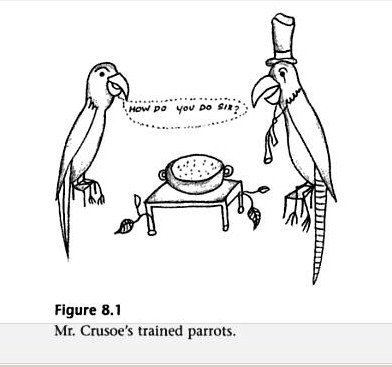
It reminded me of this figure from Eva Jablonka and Marion J. Lamb’s book “Evolution in four dimensions: genetic, epigenetic, behavioral, and symbolic” inspired by a story by Spalding (1876). The story tells of Robinson Crusoe landing on his island and teaching 2 parrots the phrase “how do you do sir?”. He continues to teach the phrase to the offspring of these parrots for some generations.  Crusoe then (because he’s on a dessert island and he’s bored) breeds the parrots who say “how do you do sir?” the best.  After a while the young parrots start to repeat the phrase so early it is not known if it is learned behaviour or instinct. It is found to have become instinct because Crusoe selected for the best learners and the parrots will presumably continue this behaviour long after Crusoe has died. Spalding then hypothesises that should the parrots acquire a taste for good English this behaviour should continue to be selected through sexual selection. Taking figure 8.1 at face value it seems the parrots are also selected for fine taste in hats and ability to sit properly on chairs.

Chomsky derides purely statistical methods

May 10, 2011 in Academia, Irreverant and Irrelevant

This month sees MIT’s Brains, Minds, and Machines symposium. The opening panel discussion was moderated by Steven Pinker and called for a reboot in artificial intelligence. The panel consisted of Noam Chomsky, Marvin Minsky, Patrick Winston, Susan Carey, Emilio Bizzi, and Sidney Brenner. Most panelists called for a reboot of old style research methods in AI as opposed to the more narrow applications of AI seen today. An article on Technology review summarizes Chomsky’s contribution:

Chomsky derided researchers in machine learning who use purely statistical methods to produce behavior that mimics something in the world, but who don’t try to understand the meaning of that behavior. Chomsky compared such researchers to scientists who might study the dance made by a bee returning to the hive, and who could produce a statistically based simulation of such a dance without attempting to understand why the bee behaved that way. “That’s a notion of [scientific] success that’s very novel. I don’t know of anything like it in the history of science,” said Chomsky.

I wondered what people thought of this argument and how it relates to the computational and statistical models used to demonstrate language that are becoming so fashionable these days.

Linguistic Structure: the Result of L2 Learners?

May 2, 2011 in Irreverant and Irrelevant, Linguistics

Wray and Grace (2007) propose that the structure of a language is dependent of the social structure of the population who speak it. Lupyan & Dale (2010) later showed this using statistical analysis. This has been discussed extensively on this blog before:

http://www.replicatedtypo.com/science/language-as-a-complex-adaptive-system/422/

http://www.replicatedtypo.com/uncategorized/memory-social-structure-and-language-why-siestas-affect-morphological-complexity/2382/

One of the proposed reasons for why large population size is thought to affect linguistic structure is that larger populations will have a larger ratio of second language (L2) speakers to first language (L1) speakers.

Languages within exoteric niches (large population and geographical spread with many language neighbors) have been shown to be more more morphologically isolating and, as a result, regular. This has proposed to be because of the biases of adult second language learners.

Esoteric languages are more irregular and morphologically complex and idiosyncratic. This is thought to be because of the biases of child learners.

There are studies which show that adult learners have a tendency to regularise languages but only under some circumstances. Hudson Kam & Newport (2009) show that adult learners will regularise unpredictable variability but only if it exists above a certain level of scatter and complexity.

As for the learning biases of children, Wray & Grace (2007) cite only one study which looked at children who were ‘native’ speakers of Esperanto (Bergen, 2001). Bergen (2001) found that the language that the children learnt displayed a loss of the accusative case and also displayed attrition in the tense system. Although Wray & Grace (2007) suggest that this explains patterns seen in esoteric communities, it may not be as straight forward as they suggest. The evidence suggests that esoteric conditions are going to display more morphological strategies in their languages which is the opposite to the biases the child learners of Esperanto are displaying. The children are rejecting morphological strategies in favour of attrition and word order.

I wanted to point out in this post that there is evidence to suggest that adult learners preserve irregularities and idiosyncrasies, while children learners regularize (suggesting the opposite to Wray & Grace).

Studies which have addressed these problems include Hudson Kam & Newport (2005) where adult learners of an artificial language preserved unpredictable variation and child learners of the same language regularized it. Hudson Kam & Newport (2009) show in a similar study that child learners of an artificial language will regularise unpredictable irregularity but, as mentioned above, adult learners will only do this where the irregularity passes a certain level of complexity.

However, some evidence does support Wray & Grace’s (2007) proposal about adult learners.  Smith & Wonnacott (2010) show that despite there being a tendency within individual adult learners to maintain the level of unpredicted variability within the language learning process, when put into a diffusion chain of adult learners the language regularises.  Smith & Wonnacott (2010) suggest that gradual processes such as this can explain the regularisation of languages over time. While this fits nicely with Wray & Grace’s (2007) theory there is still the problem that children are just as liable to regularise as adults if not more so.


This is just some relevant experiments which I thought lent something to the debate. I know there are other factors which have been proposed to have an effect on linguistic structure. I was just curious about people’s opinions on quite to what level L2 speakers have an effect.

Chris Knight Arrested

April 29, 2011 in Irreverant and Irrelevant

Sorry, this isn’t really Language Evolution related besides Chris Knight’s obvious connection to the subject but thought it would be of interest to readers of the blog.

Last night Chris Knight and Camilla Power were arrested after planning to execute effigies of Prince William at Westminster Abbey. They were arrested ahead of the royal wedding today.

A professor of anthropology at the University of East London, Chris Knight along with his partner, Camilla Power, also a anthropology lecturer at UEL, were arrested outside their home in southeast London at around 6.15pm.

They were arrested on suspicion of conspiracy to cause public nuisance and breach of the peace.

Dr Knight was seen laid down on the pavement during the arrest in an attempt to stop officers moving him into a police van. But the police prevailed and they were held in a police station overnight.

This is not the first time Dr Knight has caused trouble. He was sacked from his position in 2009, following claims that he incited violence at the G20 protests.

THE add that the camera man who was at the scene of the arrest asked Dr Knight: “Can I get your house keys so I can feed the rabbit?”

I do hope that the rabbit is OK.


Return of the Language Evolution Tree

April 20, 2011 in Irreverant and Irrelevant

A while ago, some collegues and I noticed that two prominent books on Language Evolution -Christiansen & Kirby’s Language Evolution and Fitch’s Evolution of Language – both included a picture of an acacia tree in the sunset on their covers.  On closer analysis, it turned out that they were the same tree:

Thus began the Acacia Tree Hypothesis of Language Evolution.

Following this up, I was thinking about Dediu & Ladd’s discovery that linguistic tone is has certain genetic correlates. Here’s the map of languages with linguistic tone:

However, I suspected the devious influence of acacia trees and so I found some information on their geographic distribution:

As I suspected, countries in which the acacia tree Acacia nilotica grows are significantly more likely to have tonal languages:

Tone No Tone
Acacia Trees 163 117
No Acacia Trees 104 237

(Chi-squared with Yates’ continuity correction = 47.1, df = 1, p < 0.0001, data from Crop Protection Consortium and the World Atlas of Language Structures).

The plot thickens …


Dediu, D., & Ladd, D. R. (2007). Linguistic tone is related to the population frequency of the adaptive haplogroups of two brain size genes, Microcephalin and ASPM. Proceedings of the National Academy of Sciences, 104, 10944–10949.

Fitch, W. T. 2010 The evolution of language. Cambridge, UK: Cambridge University Press.

Christiansen, M. and Kirby, S. (2003). Language Evolution. Oxford University Press.


Update:

I’ve added the images David mentioned to the post:

Also, The Babel’s Dawn blog banner

Language as a board game

April 4, 2011 in Irreverant and Irrelevant

I’ve just finished reading The Player of Games by Iain M. Banks.  Yes, I’m a little behind the times for a geek.  Anyway, I was struck by the concept of Azad in the book.  The protagonist visits an Imperial civilisation whose whole society revolves around the playing of a board game called Azad.  Except this is a vastly complicated board game, played on multiple, football-field-sized boards with semi-conscious pieces and developed over thousands of years.  In fact, the game is so complicated that you can’t play it well unless your cognitive structures have been shaped by the game from a very young age.  Here’s a little extract:

Read the rest of this entry →

Anthropologists Trace Human Origins Back To One Large Goat

February 21, 2011 in Irreverant and Irrelevant

GoatsIn what is sure to be a more cited paper than Gould and Lewontin (1979), Douglas Ochs at Columbia University, together with a team of internationally renowned scientists (and probably a few internationally unknown graduate students), has found that all of humanity can be traced back to a large Pliocene-era goat.

More interesting, for this blog at least, is the finding that the roots of early Indo-European language were in goat bleating. Unfortunately, I couldn’t track down the actual paper myself to find the details of this argument, but if you’re interested, I would suggest looking at the original article where I found this wonderful and groundbreaking study, on the popular peer-reviewed site the Onion.

Full disclosure: This post has been listed in the Irrelevant and Irreverent category, because it probably fits there. We’re not seriously suggesting that humans do in fact go back to a single large goat species in the Pliocene – that’s much too early. Rather, it’s more likely that the goat species was around in the Silurian period. It feasted mainly on trilobites.

Possible Stroke on Live Television

February 14, 2011 in Irreverant and Irrelevant

I was alerted recently of this video. It’s short, and the rest of the post won’t make sense without watching it.

My mate Ally said that “I’m sure there’s some kind of linguistic point to be made here but I have no idea what it is.” My first few times through the video, I was also confused. However, the comment section is where things become clear. At the risk of being one of those reporters who mentions twitter-posts, TopGunMD1 stated:

“Its obvious she just had a STROKE! She is currently suffering from Wernicke’s aphasia, its a very serious problem. I hope her producer realized this and took her to the hospital immediately. If you ever see someone talk like that, call an ambulance or take them to the ER immediately.”

This is most likely a correct diagnosis. What’s happened here is that she’s had a stroke which dealt a debilitating blow to her Wernicke’s area, and she’s lost her recall for words. This might be seen as normal stumbling, but for the fact that she is a reporter, which would mean that she should historically stumble only very rarely, and never this much. Around a third of stroke sufferers develop speech problems, some of which can be reversed later. It is unclear here whether she is merely experiencing aphasia or speech production errors as well.

It looks like her fellows recognised her problem very quickly, and cut back to the next scheduled thing. As well, she’s been taken to the hospital for tests – let’s hope this isn’t permanent.

Poster Venn Diagram

October 9, 2010 in Irreverant and Irrelevant

Last week I presented an academic poster over at Edinburgh. Even though I’d argue it was reasonably successful, getting lots of good feedback and some useful recommendations, I still think it could have benefited from being trimmed down to highlight the main points. I’ve uploaded it to Scribd so you can see for yourself:
Phoneme Demography Poster

Since presenting I’ve come across this insanely useful poster Venn Diagram (H/T: John Hawks):

Now try and spot which aspects I didn’t cater for in my poster (hint: direct your eyes toward the right).